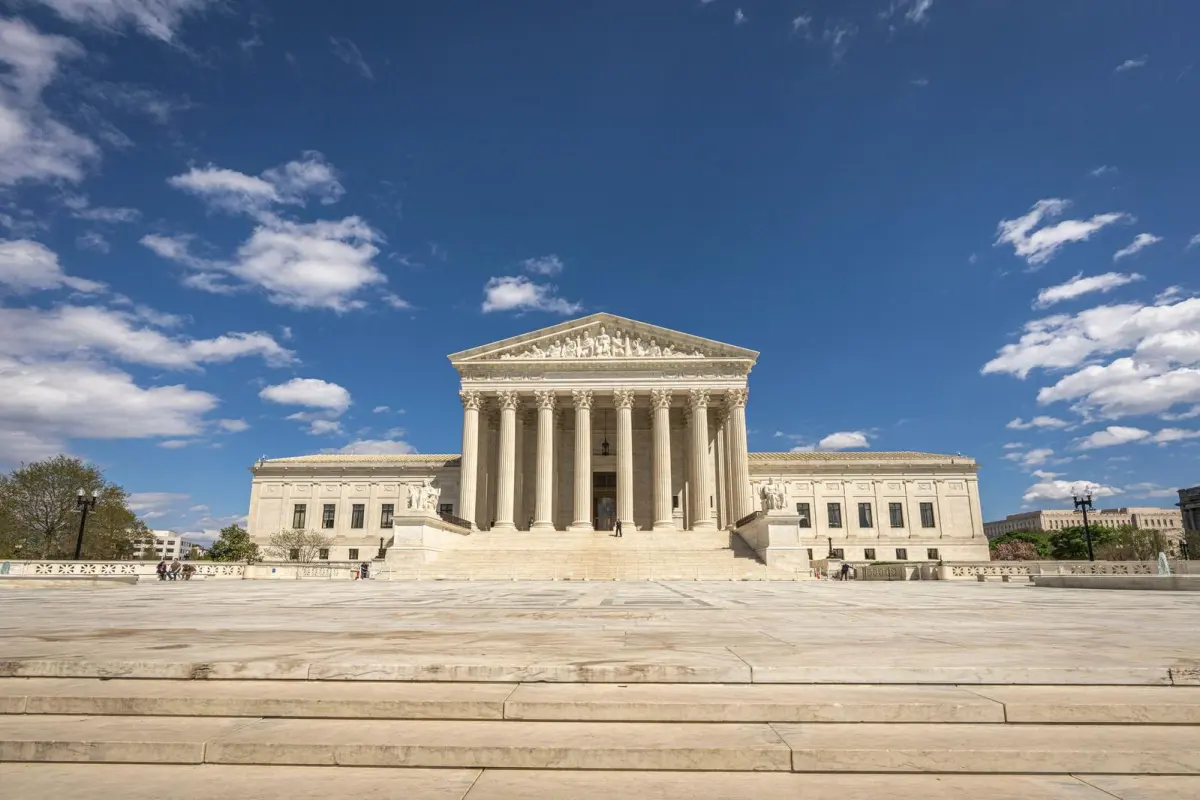
Trying to make sense of the headlines and asking how does the Supreme Court work? Nine justices serve for life, choose only a tiny share of the cases they are sent, and shape how the Constitution is read.
This guide is part of a wider series on us news explained, covering how American institutions function.
| Item | Value |
|---|---|
| Justices on the Court | Nine (one chief justice and eight associate justices) |
| Year Congress set the size at nine | 1869 |
| Size of the original court (1789) | Six justices |
| Votes needed to accept a case (Rule of Four) | Four of the nine justices |
| Share of review requests accepted | Fewer than 2 percent |
| Annual session begins | First Monday in October |
These figures come from the Lumen Learning American National Government textbook. Figures can change, so check the source and the Court’s official website before you rely on them.
Who sits on the Court and how long they serve
The Supreme Court of the United States, often shortened to SCOTUS, is more than nine people in robes. The Lumen Learning textbook describes the justices as only the top layer of an entire branch of government that includes many administrators, lawyers, and assistants.
The size of the Court has changed over time. According to the same textbook, the original court in 1789 had six justices, and Congress set the number at nine in 1869, where it has remained ever since.
The bench has one chief justice, who is the highest-ranking judge, and eight associate justices. All nine serve lifetime terms after the president nominates them and the Senate confirms them, as the UCF American Government text also states. Senate rules are a topic of their own, and a separate explainer covers what is the filibuster.
Public debate often sorts justices by ideology. The textbook notes that opinions have revealed certain ideological tendencies, but each justice considers every case as it comes and does not always rule in a predictable way. It adds that justices have often disappointed their partisan supporters.
Laws start in a different place, and a separate explainer walks through how a bill becomes a law.
What do law clerks do for the justices?
Justices do not work alone. In the Lumen Learning account, each justice has three or four law clerks, recent law school graduates who temporarily do research, help prepare the justice and assist with writing opinions.
The same text calls a clerkship a chance for thirty-six young lawyers each year to leave their fingerprints all over constitutional law. A former clerk quoted there describes the work in four parts:
- Reviewing cases: clerks join a “cert. pool” and make recommendations about which cases the Court should choose to hear.
- Preparing for oral argument: they analyze the filed briefs, which are short arguments explaining each party’s side, and the law at issue.
- Drafting opinions: they research and help write majority, dissenting or concurring opinions.
- Handling emergencies: they help with emergency applications, many from prisoners asking to stay a death sentence, sometimes filed within hours of a scheduled execution.
The textbook says the clerks’ work and recommendations influence whether the justices hear a case and how they rule. Readers who want to weigh how much that reliance matters will find the question left open there.
How does the Supreme Court pick its cases?
The Court’s annual session begins on the first Monday in October and ends late the following June, according to the textbook. Every year, thousands of people would like their case heard.
The justices select only a handful for the docket, the list of cases scheduled on the Court’s calendar. Of the many thousands of review requests that can arrive in a year, the Lumen Learning text reports that typically fewer than 2 percent are accepted, out of a possible ten thousand at most.
Occasionally, the Court fast-tracks a case with special urgency. Outside groups try to influence the choice too, and researchers disagree about how much. Earlier research found that more interest-group activity made a case more likely to be taken, while more recent research suggests that too much may have a diminishing impact.
The Rule of Four and the reasons a case is taken
Most often, the person asking for review is the petitioner, who requests a writ of certiorari, or “cert.” for short. That is a request that the lower court send up its record of the case for review.
The Court has discretion, but four of the nine justices must vote to accept a case. This is called the Rule of Four, and the Court’s Rule 10 takes precedence on decisions about cert.
The textbook says the Court is more likely to grant certiorari when lower courts conflict on an issue. Examples include:
- conflicting decisions among different courts of appeals on the same matter;
- decisions by an appeals court or a state court that conflict with precedent;
- state court decisions that conflict with federal decisions.
Reading a case name and why decisions last
Case names list a petitioner versus a respondent. On an appeal, the party unhappy with the lower court’s decision is the one bringing the appeal, and it is the first-named party.
The textbook’s example is Brown v. Board of Education (1954), in which Oliver Brown was one of thirteen parents who sued the Topeka public schools over discrimination based on racial segregation. You can read more in the source text.
Rulings matter beyond the parties. Their decisions affect the outcome of the case in front of the justices and also create lasting impacts on legal and constitutional interpretation for the future.
Frequently asked questions
How many justices are on the Supreme Court?
Show answer
There are nine: one chief justice and eight associate justices. The textbook says Congress set the number at nine in 1869 and that it has remained there ever since.
How long do justices serve?
Show answer
All nine serve lifetime terms after the president nominates them and the Senate confirms them.
How many cases does the Court take each year?
Show answer
Only a small share. The textbook says the Court typically accepts fewer than 2 percent of the as many as ten thousand cases it is asked to review every year.
What is the Rule of Four?
Show answer
It is the Court’s practice that four of the nine justices must vote to accept a case for review.
When does the Court’s term start?
Show answer
The annual session begins on the first Monday in October and ends late the following June, per the textbook.