
Worried the system is too tangled to follow? Here is separation of powers explained: the Constitution splits government into three branches, and each can check the others.
For wider context, browse the rest of our us news explained section.
| Item | Value |
|---|---|
| Branches of government | Three: legislature, executive, judiciary |
| Constitution articles for the branches | Articles I, II and III |
| House of Representatives term (as originally established) | 2 years |
| Senate term (as originally established) | 6 years, in 3 staggered classes |
| President’s term | 4 years |
| Supreme Court term | Life, during good behavior |
These figures come from a Lumen Learning US Government reading, which describes the arrangements as originally established. Details can change, so check the source before you rely on them.
What the separation of powers means
The separation of powers assigns three kinds of government action to three distinct branches. Law making goes to the legislature, law execution to the executive, and law adjudication to the judiciary, as the Lumen Learning reading explains.
The Constitution gives each branch its own article: Article I for the legislature, Article II for the executive, and Article III for the judiciary. The text has a preamble and seven articles, and the first three set up the branches, according to the same reading.
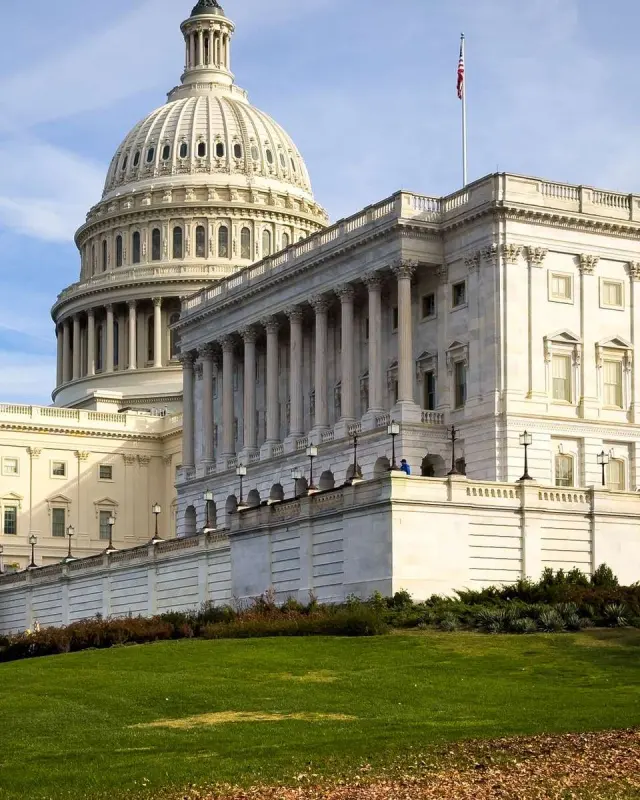
The idea even shaped the capital’s layout. Pierre L’Enfant’s plan of Washington, DC, placed the President’s House and the Capitol at opposite ends of Pennsylvania Avenue, which the reading calls an indicator of the separation.
It helps to keep this apart from federalism, which divides power between national and state governments rather than among branches. Under that arrangement, some policy areas are exclusive to the federal government, some to the states, and others are shared, as the reading notes. Our explainer on what is federalism covers that second division in full.
What each branch does
Each branch is assigned specific powers that only it can wield. The Lumen Learning table of the original design lists them as follows.
- Legislative: the House has 2-year terms, initiates revenue legislation and brings articles of impeachment. The Senate has 6-year terms, confirms executive appointments and treaties, and tries impeachments.
- Executive: the president serves 4 years, is commander-in-chief, nominates executive officers and Supreme Court justices, and can veto. The president also convenes both houses of Congress and issues reprieves and pardons.
- Judicial: Supreme Court justices serve for life during good behavior, through presidential appointment and Senate confirmation. Their central power is judicial review.
Article I was meant to be the heart of the new government, and it lists many areas where Congress may act. The same reading says the president’s powers are far fewer than those enumerated for Congress.
Because the table describes the original design, check later changes before treating every detail as today’s rule. The senators’ selection method, listed there as election by state legislatures, is one example of a detail worth verifying.
How checks and balances work
Separate branches do not work alone. Political scientist Richard Neustadt wrote that the Constitutional Convention of 1787 “created a government of separated institutions sharing powers,” and the reading adds that whether the founders intended this is still open to dispute.
Under checks and balances, each branch can respond to, and if necessary block, the others. Only Congress can pass a law, but the president can veto it. Supreme Court justices can declare an act of Congress unconstitutional through judicial review.
Judicial review is not mentioned in Article III. It was asserted in the 1804 case of Marbury v. Madison, per the Lumen Learning reading.
The logic reflects James Madison’s skeptical view of human nature. In Federalist No. 51 he argued the Constitution gives officeholders “the necessary constitutional means and personal motives to resist encroachments of the others.” In Federalist No. 10 he held that even officials follow their own selfish interests, according to the reading.

Why Congress has two chambers, and why the system is slow
The legislature is itself split into two chambers, the House of Representatives and the Senate. This bicameralism builds a check inside the legislative branch, since the two chambers are roughly equal in power, according to the Lumen Learning reading.
The reading shares a story it calls possibly fanciful. Thomas Jefferson asks Washington why Congress needs two chambers, and Washington answers that legislation is poured into the Senate “saucer” to cool it, as coffee was in that era.
The wider design is built to resist quick agreement. Officeholders have different terms, selection methods and constituencies, so maintaining the status quo is more likely than enacting significant changes. The reading says exceptions occur in response to dire situations such as a financial crisis or external attacks.
Where the lines blur in practice
A policy-research summary updated May 17, 2026 says the boundaries blur in practice. Congress delegates lawmaking authority to agencies, courts shape policy through interpretation, and the president issues executive orders that function like legislation, per that summary. For a plain-language primer, read our guide on what is an executive order.
The nondelegation doctrine holds that Congress may not hand its legislative power to the executive branch. The same summary says it was last used to strike down a federal statute in 1935, and that courts have since upheld delegations when Congress supplies an “intelligible principle,” a test dating to 1928.
As of that May 17, 2026 update, the summary reports that several justices have signaled willingness to revive the doctrine. It also says the major questions doctrine, applied in West Virginia v. EPA in 2022, works as a practical limit by requiring clear authorization for significant agency actions.
For disputes over presidential power, the summary points to Justice Jackson’s concurrence in Youngstown Sheet & Tube Co. v. Sawyer (1952). It describes three zones:
- With express or implied congressional authorization, executive power is at its maximum.
- When Congress is silent, the president acts in a “zone of twilight” where authority is uncertain.
- When the president acts contrary to Congress’s will, executive power is at its “lowest ebb.”
Other landmark rulings involve removal and review. INS v. Chadha (1983) struck down the legislative veto, and Seila Law LLC v. CFPB (2020) held that Congress cannot insulate a single-director agency head with for-cause removal protection. After Loper Bright (2024), the summary says courts no longer defer to agencies’ readings of ambiguous statutes; check it and the underlying opinions for the latest status.
Frequently asked questions
Is separation of powers the same as checks and balances?
Show answer
They are related but distinct. Separation of powers assigns law making, execution and adjudication to separate branches, while checks and balances let each branch respond to, and if necessary block, the others, according to the Lumen Learning reading.
Where does the Constitution set up the three branches?
Show answer
Article I covers the legislature, Article II the executive, and Article III the judiciary, per the reading.
Does the Constitution mention judicial review?
Show answer
Not in Article III. The reading says the power was asserted in the 1804 case of Marbury v. Madison, and the table of powers notes it is stated more directly in Federalist No. 78.
Why was the system designed to be slow?
Show answer
The design aims to prevent quick agreement within the legislature and between the branches. The reading says this makes the status quo more likely to continue than significant change.