
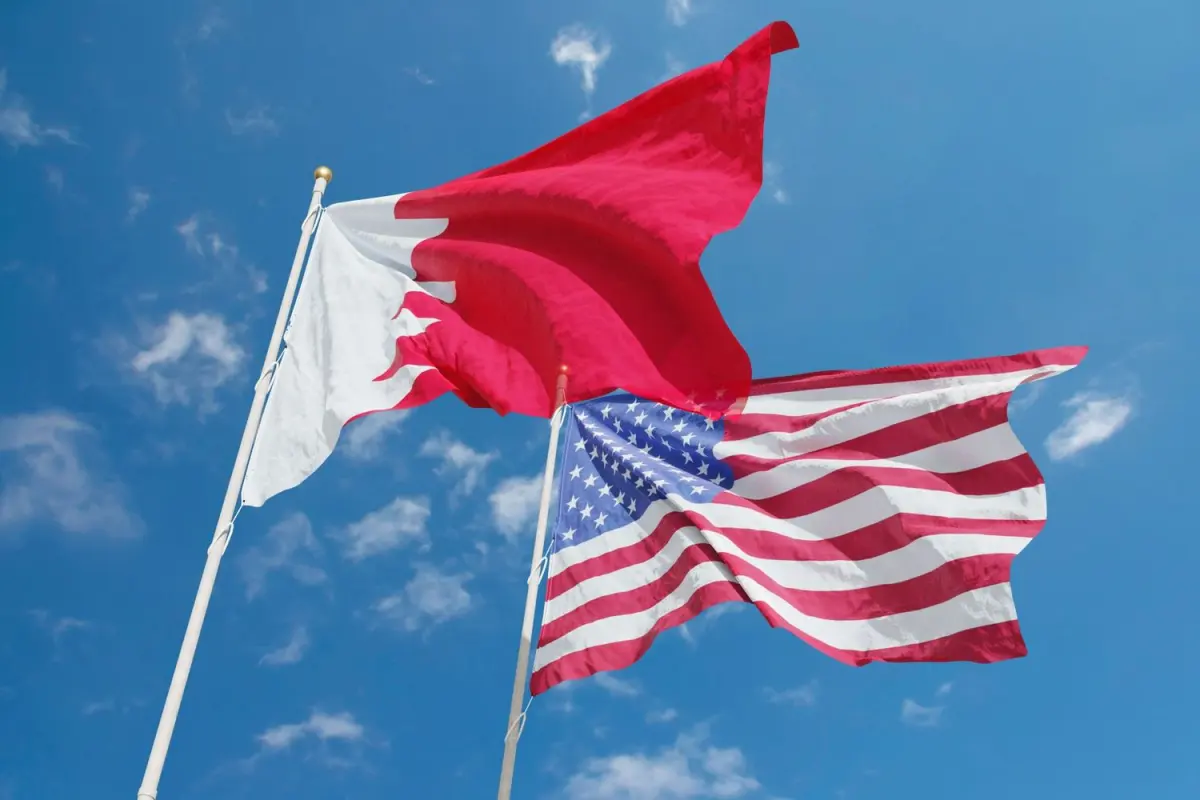
If you’re trying to get US China relations explained, here’s the short version: the two largest economies compete and trade at once. As of a September 2026 congressional update, Washington says it seeks a “stable peace” with Beijing.
This guide belongs to our world news explained series, which covers foreign affairs in plain language.
| Item | Value |
|---|---|
| US–China goods trade, 2024 | $582.5 billion |
| US goods exports to China, 2024 | $144.2 billion |
| US goods imports from China, 2024 | $439.6 billion |
| US direct investment stock in China, 2024 | $122.9 billion |
| Trump–Xi summits held since 2025 (as of Sept. 22, 2026) | Two |
| Some paused tariff and export control actions | Paused until November 2026 |
Figures come from the Congressional Research Service (CRS) trade overview, updated September 9, 2025, and its China primer, updated September 22, 2026. Figures can change, so check the source before you rely on them.
A short history of US–China ties
The modern relationship starts in 1949, when Mao Zedong’s Communists established the People’s Republic of China in Beijing. According to the Council on Foreign Relations (CFR) timeline, updated April 15, 2025, the Nationalist leader Chiang Kai-shek fled to Taiwan, and the United States supported his exiled government, setting the stage for several decades of limited US relations with the mainland.
The same timeline marks these turning points:
- 1950–1953: The Korean War put US and Chinese forces on opposite sides, and as many as four million people died before the armistice (CFR).
- 1971: China’s ping-pong team invited the US team to China on April 6, the first public sign of warming relations (CFR).
- 1972: President Richard Nixon spent eight days in China and signed the Shanghai Communiqué (CFR).
- 1979: The United States granted China full diplomatic recognition and severed normal ties with Taiwan (CFR).
- 1989: After the Tiananmen Square crackdown, the US suspended military sales to Beijing and froze relations (CFR).
The CFR summarises the pattern as periods of both tension and cooperation over issues including trade, climate change and Taiwan (source).
What US policy says in 2026
As of CRS’s September 22, 2026 update, the United States and China lead the world in the size of their economies, defense budgets, and research and technology investments. Both are also among the five nuclear-armed, veto-wielding permanent members of the UN Security Council (CRS).
The framing has shifted. The first Trump administration and the Biden administration described the relationship as “strategic competition,” while the second Trump administration says it seeks a “balance of power” and a “stable peace” with China (CRS).
That stance appears in the December 2025 National Security Strategy and the January 2026 National Defense Strategy. CRS says the language is conciliatory in places and combative in others, which could reflect strategic framing, internal policy differences, or both. The defense strategy also states that its approach toward the PRC “does not require regime change” (CRS).
At a May 2026 summit, the two presidents committed to “build a constructive relationship of strategic stability.” A White House fact sheet added the phrase “on the basis of fairness and reciprocity,” which CRS notes is absent from PRC readouts (CRS).
Trade, tariffs and technology
China is the second-largest global economy and has been a top US trading partner since joining the World Trade Organization in 2001, according to the CRS trade overview. In 2024 China was the fourth-largest US goods trading partner, with total trade of $582.5 billion: $144.2 billion in US exports and $439.6 billion in imports.
The same report puts US direct investment stock in China at $122.9 billion in 2024, against $34.0 billion of Chinese investment stock in the United States. It also says that in February 2025 over 80% of American Chamber of Commerce members reported that a lack of market access was affecting their PRC operations (CRS).
The tariff dispute has a long run-up. After a 2018 Section 301 finding that included forced technology transfer and cyber-enabled theft of intellectual property, the US Trade Representative imposed tariffs of 7.5% to 25% on about $370 billion of imports from China, and Beijing countered on $110 billion of US trade. A 2020 Phase One deal addressed some issues but did not resolve many of those the USTR had raised (CRS).
Since 2025 the Trump administration has increased tariffs on China and other countries. Beijing has answered with tariffs, market restrictions and export controls on inputs such as rare earths, and most of its retaliation since 2025 has been nontariff because it ran out of items to tariff effectively (CRS, September 2026).
The legal basis for US tariffs has also moved. CRS’s May 11, 2026 update reports that after the Supreme Court ruled in early 2026 that the President cannot use IEEPA to impose tariffs, he lifted them and imposed a 10% global tariff for 150 days under Section 122 (CRS, May 2026). As of the September 2026 update, both sides had paused some tariff and export control actions until November 2026, though some say PRC follow-through has been uneven, so check for later developments.

Technology is a second front. CRS reports that the administration’s decision to let Nvidia export its H200 chip to the PRC, with the US government collecting 25% of the proceeds, prompted congressional legislation to limit sales of advanced chips and chipmaking equipment. Former US officials criticized the licensing decision, according to the September 2026 CRS update.
Taiwan and the military balance
Taiwan has been a recurring flashpoint. The CFR timeline records a First Taiwan Strait Crisis in 1954, when the US signed a mutual defense treaty with Chiang’s Nationalists, and says crises erupted again in 1956 and 1996 (CFR).
After the 1979 shift in recognition, Congress passed the Taiwan Relations Act in April. The act allows continued commercial and cultural relations and requires Washington to provide Taipei with defensive arms, but the CFR says it does not officially violate the One-China policy (CFR).
In 1982 the Reagan administration issued the Six Assurances to Taiwan. They included pledges to honor the Taiwan Relations Act, not to mediate between Taiwan and China, and to set no date to end arms sales (CFR).
The January 2026 National Defense Strategy makes no mention of Taiwan, yet it states an intention to erect a strong denial defense along the First Island Chain, which includes Japan, Taiwan and parts of the Philippines and Indonesia (CRS, September 2026). In its May 2026 update, CRS describes Taiwan as a self-governing democracy of 23.3 million people over which the PRC claims sovereignty.
Summits, officials and Congress
The current approach leans on leader-level diplomacy. The October 30, 2025 meeting in Busan, South Korea, was the first in-person Trump–Xi meeting since 2019, and the May 14-15, 2026 Beijing summit was the first presidential visit to China since 2017 (CRS).
As of the September 22, 2026 update, Xi’s state visit to Washington was planned for September 23-25, 2026, and Xi had invited President Trump to the APEC Leaders’ Meeting in Shenzhen in November 2026. Check recent coverage to see which of these meetings took place (CRS).
At Busan the leaders also agreed to set up two cabinet-level channels (CRS):
- An economic track, led by the US Treasury Secretary and a PRC vice premier.
- A political track, led by the Secretary of State and China’s top diplomat.
Congress pulls in a more competitive direction. The 119th Congress reauthorized the House Select Committee on the Strategic Competition Between the United States and the Chinese Communist Party, and it has focused on the challenges and risks China poses to US interests (CRS).
Readers who want to understand formal international agreements can find a companion explainer on how are treaties ratified in the us.
Alliance systems are a separate topic, and a further explainer on how does nato work shows how one such system is organised.
Frequently asked questions
What is the One-China policy?
Show answer
In 1979 President Jimmy Carter granted China full diplomatic recognition, acknowledged mainland China’s One-China principle and severed normal ties with Taiwan. Congress then passed the Taiwan Relations Act, which requires defensive arms for Taipei, per the CFR timeline.
Does US defense strategy call for regime change in China?
Show answer
As of the January 2026 National Defense Strategy, as summarised by CRS in September 2026, it does not. The strategy says its goal is to prevent anyone, including China, from being able to dominate the US or its allies.
How much do the two countries trade?
Show answer
In 2024, total US goods trade with China was $582.5 billion, including $144.2 billion of US exports and $439.6 billion of imports, according to the CRS trade overview. Those figures cover goods only.
How often do the two leaders meet?
Show answer
As of CRS’s September 22, 2026 update, they had held two summits since 2025, with up to three more possible that year (CRS). Check recent reporting for what has happened since.